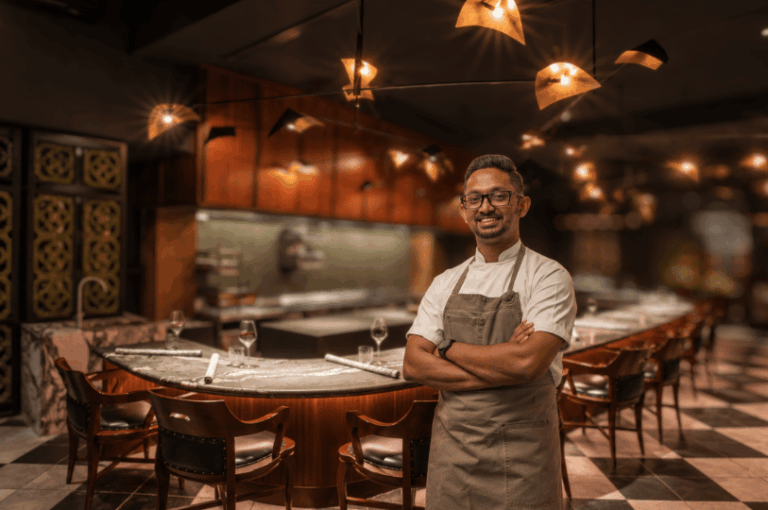
Damian D’Silva Wants Singapore to Remember How It Used to Taste

Some recipes disappear with a bang. Others vanish one quiet dinner at a time.
For Damian D’Silva, remembering begins with his grandfather, Gilmore. Long before restaurant kitchens and television appearances, there was a boy watching his granddad cook, listening as ingredients came with stories attached. Gilmore did not simply feed him. He taught him that food carried history, and that knowing where a dish came from mattered almost as much as knowing how it tasted.
That lesson became more urgent after Gilmore was gone. His recipe book survived, but many entries were little more than ingredient lists. D’Silva has recalled spending nine months studying, testing and rewriting those recipes, trying to answer a deceptively emotional question: is this how it was supposed to taste?
That question follows you to the table.
Take carne picada, one of D’Silva’s childhood favourites: minced beef cooked with onions, dark soy and warm spices. Or curry mohylu, an old Eurasian preparation that D’Silva makes with fish or prawn balls according to what is in season. These are not dishes engineered to trigger nostalgia in everyone. Many younger diners may have no memory of them at all.
And perhaps that is precisely why serving them matters.
Christmas debal tells the story particularly well. Traditionally associated with Boxing Day in Eurasian homes, the fiery curry grew from Christmas leftovers, sharpened with vinegar and spice. On a restaurant plate today, it can feel wonderfully alive: hot, sour, rich and unruly. Yet behind that pleasure sits something fragile—the domestic rituals that once told people when to cook it, whom to share it with, and why it existed.
It is the kind of meal that might send me back to The Best Restaurants In Singapore That Deserve a Spot on Your Dining List, wondering how many memorable restaurants are also quietly protecting stories we almost stopped telling.
D’Silva’s approach is interesting because he does not seem interested in turning heritage into glass-cased history. At Rempapa and Gilmore & Damian D’Silva, old recipes continue to be cooked, adjusted, ordered and eaten. That distinction matters. Food survives differently from an artefact. It needs hands to prepare it, mouths to taste it and, eventually, another generation willing to crave it.
Singapore’s palate is always changing. Convenience changes how we cook. Ingredients disappear. Labour-intensive dishes become harder to justify. D’Silva has pointed to preparation time, disappearing spice makers and changing habits as some of the reasons lesser-known Eurasian dishes have become harder to encounter. A recipe can remain perfectly written down while the instinct for how it should taste fades.
Maybe that is the real danger D’Silva is cooking against.
A recipe can tell you how much spice to add. It cannot recreate your grandfather standing beside the stove. It cannot explain why a particular curry appeared after Christmas, or why one family made it differently from another. Those details live in people.
So when an unfamiliar old dish arrives at the table, the most important reaction may not be, “I remember this.”
It may simply be: “Tell me more.”