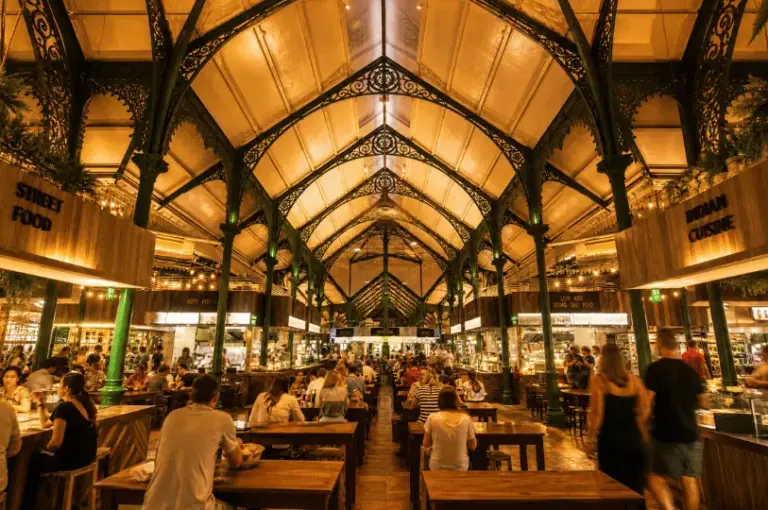
The Things Nobody Tells You About Eating at a Singapore Hawker Centre

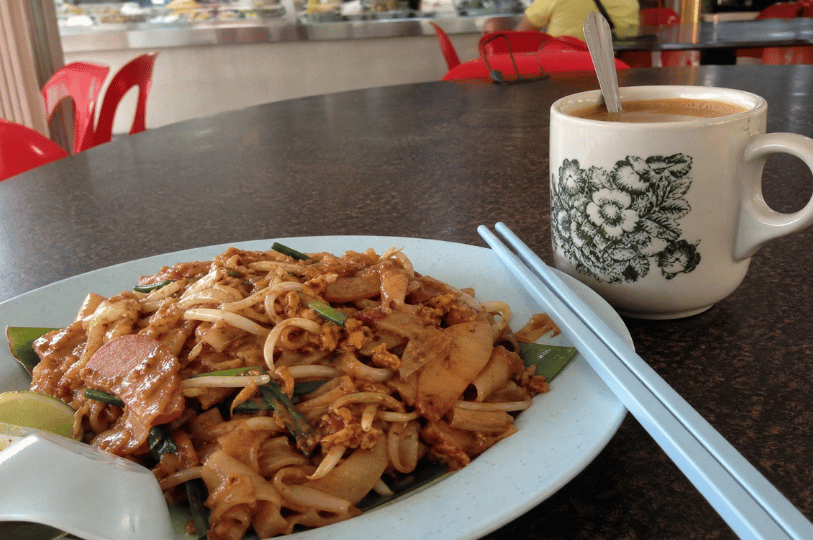
It’s 12:15pm. You have a plate of char kway teow in one hand and a kopi in the other.
Then you spot it: an empty table near the fan. No people, no bags. Just a small packet of tissues sitting in the middle.
You stop.
Is it free? Did someone forget their tissues? Or is that packet quietly saying this one’s taken, thanks?
Most people who grew up here don’t even pause. They keep walking. For everyone else, it can feel like a test nobody warned you about.
Here’s the thing, though. That tissue packet isn’t really a rule. It’s a sentence in a language that hawker centres have been speaking for a long time, the language of sharing a crowded room with hundreds of strangers.
Once you understand that, most of the “rules” stop feeling like rules.
The Things Nobody Really Explains
Nobody hands you a manual at the entrance. There’s no host asking how many are in your party.
You walk in, and the system expects you to pick up its rhythm.
Most hawker etiquette is learned by watching: someone leaves tissues on a table, a family splits up to queue at different stalls, someone carries a tray to the rack after eating.
Some of these habits are courtesy. Some are common practice. And a few are actual rules that can be enforced.
That difference matters. Once you know which is which, the whole place becomes easier to navigate.
The Tissue Packet Is Saying Something
Let’s start with the famous one.
“Chope” is the local word for reserving something, usually a seat. The method is low-tech: a tissue packet, an umbrella, a staff pass, sometimes a phone if someone is feeling very trusting. Place it on the table, and the table is spoken for while you go and queue.
It’s a strangely elegant system. A 50-cent packet of tissues works as an informal reservation, and nobody needs an app.
Now, the part people get wrong. In 2025, a viral claim said people would be fined for choping seats. The National Environment Agency stepped in and said plainly: no fines for choping, and no “chope-free” zones.
So chope isn’t illegal. But it isn’t a legal claim to a table either. It’s a social signal, and it works because almost everyone agrees to respect it.
For most diners, the practical answer is simple. If something has clearly been placed on a table on purpose, treat it as occupied. Don’t move the tissues and sit down. That’s the hawker equivalent of taking someone’s chair while they’re at the buffet.
Good to Know
Choping is a custom, not a law. It’s widely understood and widely respected, which is exactly why it works.
An Empty Seat Doesn’t Always Mean an Empty Table
This is where hawker centres and restaurants part ways completely.
At a restaurant, the table is yours. You booked it or were shown to it, and nobody else will sit down halfway through your laksa.
At a hawker centre, the table is part of a larger system.
The National Heritage Board describes hawker centres as “community dining rooms,” places where people from different backgrounds gather, eat, and talk. When UNESCO inscribed Singapore’s hawker culture on its list of Intangible Cultural Heritage in 2020, part of what it recognized was exactly this: people dining at shared tables, sometimes with strangers.
So if you spot a free seat at a table where two office workers are halfway through their noodles, asking whether you can sit there is completely normal. Especially at lunch.
You don’t need a whole table to yourself. You need a seat, and maybe a little elbow room.
The courtesies here are small. Keep your bags off the extra chairs. Don’t spread across a table for four when you’re eating alone at the busiest hour. Shift over when someone asks. None of these are written down anywhere. They just make the room work.
The Queue Is Part of the Meal
The usual rhythm goes something like this: find a seat, look around the stalls, join a queue, order, wait, then collect your food. At some stalls, they’ll ask for your table number and bring it over, so it helps to remember yours.
The part I find interesting is what the queue is actually for. It isn’t just waiting. It’s thinking time.
The easiest way to slow down a busy stall is to reach the front and only then start reading the whole menu. That’s not bad manners, exactly. It’s just inefficient, and at a popular stall at noon, a few extra seconds per person adds up quickly.
So the queue is when you decide. Chicken or char siew. Big or small. Chilli or no chilli.
It also helps to know there’s no single ordering system. Some stalls take your order and call a number. Some hand you a buzzer. Some ask where you’re sitting. Some are fine with small requests, while others are working too fast to customize much. The practical approach is to watch the person in front of you and follow the stall’s lead.
A Little Tip
If you’re new, stand back for a minute and watch how two or three people order. You’ll learn the stall’s whole system faster than any sign could explain it.
You Don’t Need Singlish to Order Chicken Rice
This worry comes up more than you’d think, especially with visitors.
You don’t need to speak like a local. English is generally enough at most stalls. Pointing at a photo works. So does saying the dish number.
The person behind the counter has seen every kind of order. A clear point and a nod will get you exactly what you came for.
You probably don’t need to worry as much as you think.
Your Meal Isn’t Over Until the Tray Goes Back
This is where “unwritten rule” stops being the right phrase.
Returning your tray and crockery, and clearing your table litter, is not just a nice thing to do anymore. At hawker centres, it has been subject to enforcement since 1 September 2021. That includes used tissues, wet wipes, wrappers, drink cans, and food remains like bones and shells. Leaving them behind can count as an offence.
There are sensible exceptions. NEA doesn’t take action against people who clearly can’t clear their tables, such as frail elderly diners, people with disabilities, and young children. The expectation is that their companions help where they can.
The reasoning is quite practical. When diners return their own trays, cleaners spend less time making repeated clearing rounds and more time actually wiping tables down. During a busy lunch, that’s the difference between a table turning over quickly and a table sitting messy while people hover nearby.
It sounds minor, but one person’s five-second walk to the tray rack can save the next person a five-minute wait for a clean seat.
And here’s the part that stays with me. In August 2021, before enforcement began, the average tray and crockery return rate at hawker centres was 65%. By 2026, it was 94%. In the first half of 2026, NEA issued 52 warning letters and three fines.
Three fines. That’s not a story about punishment. It’s a story about a habit that took hold. Something once encouraged as social responsibility has quietly become part of the routine, like reaching for the chilli.
Rule, Custom, or Courtesy?
Here’s the quick sorting:
| Practice | What it is |
|---|---|
| Returning trays and crockery | Enforced rule at hawker centres |
| Clearing tissues, bones, shells, and wrappers | Enforced rule at hawker centres |
| Smoking only in designated corners | Formal restriction |
| Choping with tissues or an umbrella | Widely respected custom, not illegal |
| Sharing tables with strangers | Common practice |
| Deciding your order while queueing | Courtesy that keeps things moving |
| Not hogging extra seats at peak hours | Courtesy |
| How each stall takes orders | Varies by stall |
What These Little Habits Say About Singapore
Look at the habits together and a pattern shows up.
Chope exists because seats are limited and shared. Table sharing exists because the room is communal. Queues exist because popular stalls serve huge volumes. Tray return exists because cleaning works better when everyone does a small part. Splitting up to order from different stalls makes sense because a hawker centre is many kitchens under one roof.
None of it is random. The etiquette grew around the shape of the place.
At a full-service restaurant, the staff manage most of your experience. They seat you, take your order, clear your plates.
At a hawker centre, you manage part of it yourself. And so does everyone else at the next table.
That’s why the etiquette isn’t really about being “a good Singaporean.” It’s about remembering that the person who sits down after you deserves the same clean table and the same chance at a quiet lunch.
If you’d like to see this in a real room, Havelock Road’s long-running stalls make a good starting point. Here’s a closer look at Havelock’s hawker scene and where to begin.
For more stories about how and why we eat the way we do, you can explore the wider dining scene.
FAQ
Is choping a seat illegal in Singapore?
No. NEA confirmed in 2025 that there are no fines for choping and no “chope-free” zones. It’s a widely respected social custom.
Can I sit with strangers at a hawker centre?
Yes. Table sharing is normal, especially when it’s busy. Asking whether a seat is free is perfectly polite.
Do I really have to return my tray?
Yes. Returning trays and crockery and clearing table litter has been enforced at hawker centres since September 2021, with exceptions for people who clearly can’t, like frail elderly diners, people with disabilities, and young children.
Do I need cash?
Not always. Many stalls accept digital payments, but methods vary, so some cash is a useful backup.
How do I check a stall’s hygiene rating now?
The old A/B/C/D grades were replaced by SFA’s SAFE framework in January 2026. Scan the QR code on the stall’s SFA licence.
Back to the Tissue Packet
So, that table near the fan. The one with the tissues.
It isn’t free. Someone is probably in the duck rice queue right now, trusting a small paper packet to hold their place. And it will, because almost everyone in the room has agreed, without saying a word, that it should.
The tissue packet is a tiny thing. So is carrying a tray back. So is moving your bag when someone asks for the seat beside you.
On their own, none of these gestures seem important. Put them together, though, and you get something that looks a lot like hawker culture itself: thousands of strangers sharing one room, one set of tables, one long lunch hour, without anyone having to tell them every move.
You just take your plate, find your seat, and leave it clean for whoever comes next.