Covent Garden Kway Chap Is Where A Havelock Road Morning Comes Together

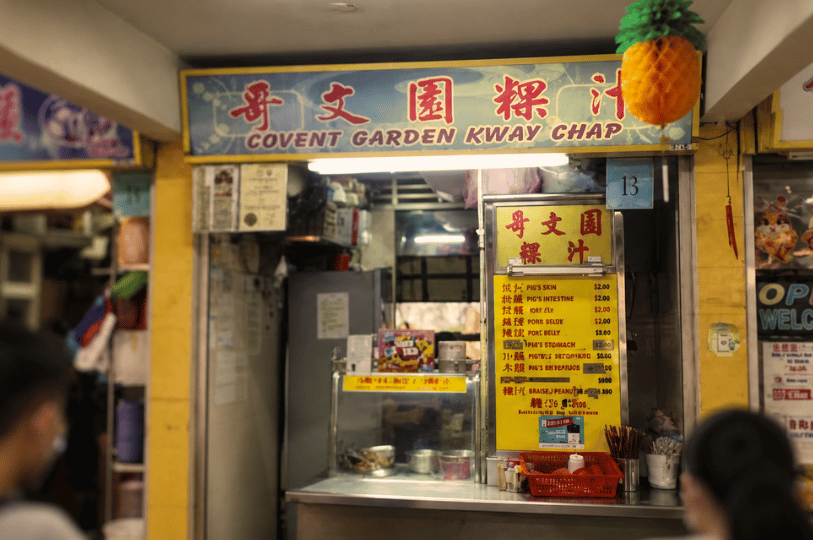
The name evokes images of a London theatre ticket.
Instead, it adorns a Teochew kway chap stall nestled within a long, narrow hawker centre on Havelock Road. Before 7:30 on a weekday morning, trays of braised intestines are already prepared and waiting.
The name isn’t a marketing ploy. It’s a legacy. The stall originally operated at Covent Garden Food Centre before relocating to Havelock Road Cooked Food Centre in 2007. When it moved, it brought along its name and the loyal patrons who recognized it.
That’s the first subtle detail worth noting at Covent Garden Kway Chap. And there are many more.
A Family Stall With Deep Roots
Mdm Chua Meow Ching began selling kway chap in 1964 at Kim Seng Community Centre. From there, the stall moved to Covent Garden Food Centre, and finally settled at Havelock Road. It has always been a family-run business. Mdm Chua has since retired, with her son now carrying on the tradition.
This matters because older articles still feature her behind the counter. She’s no longer there, but the methods she established and the family’s dedication to braising pork offal for six decades remain.
One such tradition is famously unglamorous. The family has long invested real effort into thoroughly cleaning the offal and cooking it twice to remove any odors before braising. Whether every current step mirrors the old routine is unknown to those outside the kitchen, but the intention is evident on the plate. The intestines here are known for their clean taste, which often distinguishes a good bowl of kway chap from a disappointing one.
The Ambience at Havelock Road Cooked Food Centre
No one visits Havelock Road Cooked Food Centre for its décor.
The space is long and narrow, with one row of stalls facing two rows of shared tables. The layout is practical rather than spacious. Seating is generally available, but you’ll likely share your table and elbow room. There’s no air-conditioning, no host, just a tray, a spoon, and whoever happens to be dining beside you.
It feels like a neighborhood food centre in its purest form. People come for breakfast or an early lunch, eat with purpose, and leave. The stall fits this rhythm perfectly, as does the setting—ideal for those seeking a quiet, unhurried bowl rather than a cozy morning.
If you find yourself lingering around Havelock a bit longer, you can keep exploring here and see what else is worth eating nearby.
The Covent Garden Kway Chap Menu: No Sets, Just Choices
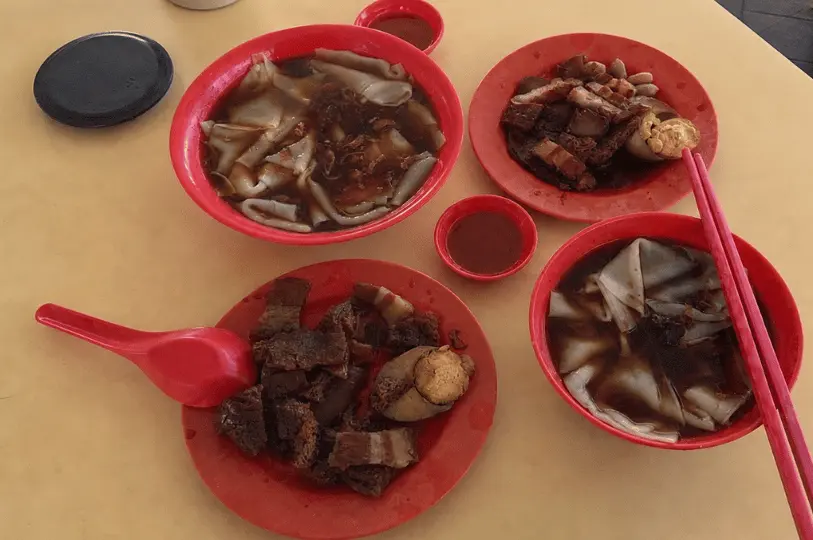
Covent Garden Kway Chap is located at #01-05, Havelock Road Cooked Food Centre, 22A Havelock Road, Singapore 161002.
Most kway chap stalls hand you a fixed combination. Covent Garden lets you choose.
That is the defining feature of the menu. You start with a minimum order and then build your plate one braised ingredient at a time. Want a plate heavy on intestines? Fine. Want no intestines at all? Also fine. The format has been part of the stall for decades, and it is still in place in 2026.
A basic one-person portion starts at S$3.50. A recently documented version came with pig intestines, pig skin, tau pok, half a braised egg, and a bowl of kway. A larger platter for two, at around S$9, came with two bowls of kway, more innards, a whole egg, tau pok, tau kwa, and fish cake.
Recent add-on prices look like this:
| Item | Price |
|---|---|
| Small intestine | S$0.50 |
| Tau pok | S$0.60 |
| Bowl of kway | S$0.60 |
| Braised egg | S$0.80 |
| Fish cake | S$0.80 |
| Tofu | S$1 |
| Big intestine | S$2 |
Hawker prices drift over time, so treat these as a recent snapshot rather than a fixed price list.
The Kway, the Broth, and the Intestines
The kway
If you’re new to the dish,
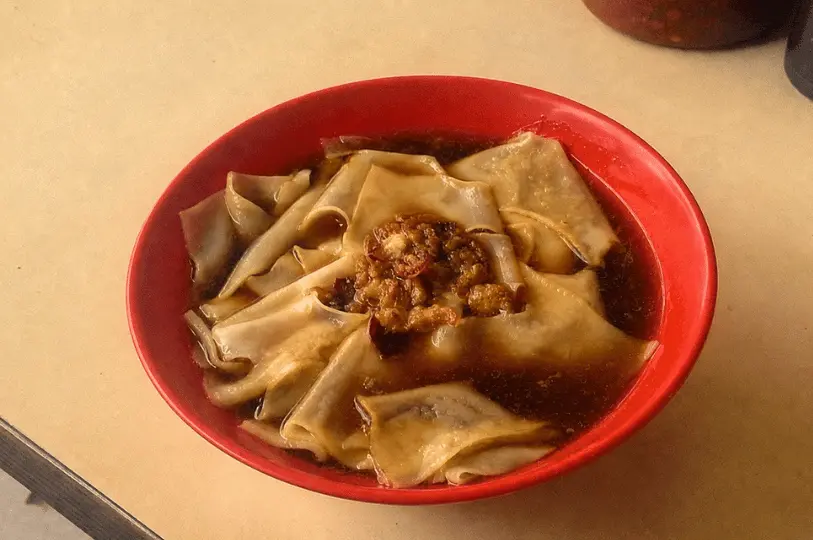
the kway is the reason it’s called kway chap. These are broad, flat rice sheets served in broth. Here they are soft, smooth, and slippery, the kind that slide off the spoon unless you’re paying attention. The kway matters as much as the offal. It’s the quiet part of the bowl that holds everything else together.
The broth
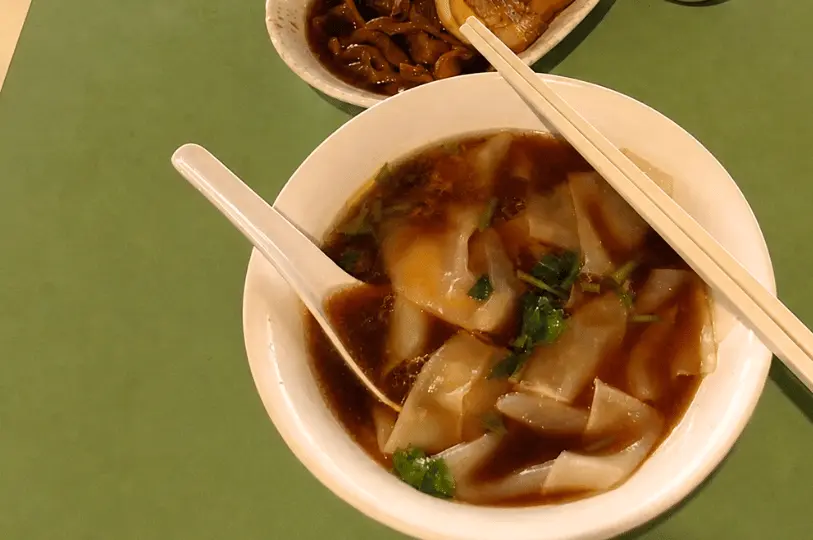
This is where Covent Garden Kway Chap parts ways with its darker, more medicinal cousins. The broth is light, with subtle herbal notes and a balanced, unsalty profile. It’s built to support the other components, not to overwhelm them, so each one keeps its own flavor.
If your idea of kway chap is a deep, almost inky herbal braise, this restraint may read as too gentle. If you’ve ever found heavy versions tiring by the fifth spoonful, it may feel like relief.
The small intestine
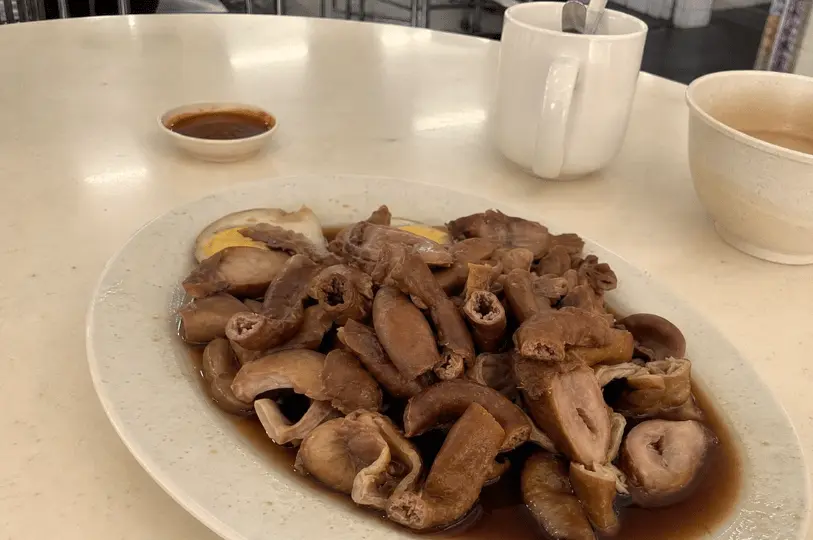
At S$0.50, the small intestine is the cheapest thing on the board. It’s also the item most often singled out. It is clean-tasting, with a pleasing texture and none of the odor that tends to put people off offal for life. It is, in a sense, where the old double-cooking habit earns its keep.
Service and the Queue
Service is quick and transactional, as you’d expect at a hawker stall. You point, they portion, you pay, you eat. Because orders are handled briskly, the queue tends to move efficiently even when the stall is busy.
Older reporting placed the peak between 9am and 11am, with waits of around 10 to 20 minutes back then. That was before the founder retired, so read it as a rough guide rather than a promise. What doesn’t change is the closing time. The stall winds down by early afternoon, and coming closer to opening gives you the fullest choice.
The real hospitality here is the freedom to decide exactly what goes in front of you.
For more neighborhood food stories and reviews like this one, you’ll find them at Best Dining Guide SG.
The Ritual Is In The Choosing
Covent Garden Kway Chap hasn’t reinvented anything, and that seems to be the point.
Its identity rests on a few quiet decisions kept over a very long time. The offal is cleaned with patience. The broth is light enough to let each ingredient speak. The kway is smooth. And the plate is yours to compose.
The stall has changed addresses and hands. The founder has retired. The way of eating has stayed.
It probably won’t win over anyone hoping for a dark, heavily herbal bowl, a fiery chili, or a comfortable seat. But for a diner who likes to stand at a counter, point at a tray of braised intestines, and ask for exactly this much of that, it offers something that’s becoming rarer.
A meal that still asks what you’d like.
 Impression
Guang Fa Laksa in Havelock Road Makes Cockles The Main Event
11 Nov 2026
Read story
 Impression
Meta Restaurant Mohamed Sultan: A Meal Shaped By Memory, Korean Roots And Change
28 Oct 2026
Read story
 Impression
Saint Pierre One Fullerton Is A Reminder That Restraint Can Be Powerful
23 Oct 2026
Read story